

The first question we get from birders coming to the island is ‘Can you recommend locations to visit to spot birds?’ This question has many different answers. Curaçao might be relatively small in surface, but has an incredible variety of both native birds, migratory birds and new introductions whether by natural forces, or mankind, non-problematic of invasive. It all depends on what species you want to see exactly and how much time you have to spend searching for birds. In this series we introduce you to a variety of areas depending on the type of birds you want to see. With some tips and tricks and do’s and don’ts. This is the third article in a series of 10!
Crested Caracara
Curaçao has four (4) native resident species of birds of prey, the White-tailed hawk, the American kestrel, the Barn owl and the Crested Caracara, and one (1) relatively new natural introduction, the Black vulture.
Crested caracara’s are a favorite on the bird species lists provided by visitors to the island who want to get acquainted with the avifauna. The species has long been abhorred on the island by the local inhabitants, due to stories of Caracara’s selecting newborn goats and killing them en masse. For this reason the bird was hunted almost to extinction in the 70’s and 80’s of the last century. But is has come back from this brink and is now thriving on the island. The numbers are now to such an extent that you will even find them in the middle of the most urban locations.
Carrion eaters

Crested caracara’s are known carrion eaters and most people do not realize these birds can also be very agile hunters. These birds spend much of their time sitting on a perch like a lamp post or a high tree, but also like to wander on the ground, displaying chicken-like behavior. When spooked the birds will first start walking away and will only start flying when a faster escape is necessary. They will also hunt on foot, walking between low shrubs and grass, on the lookout for large insects such as grasshoppers, small reptiles such as lizards and snakes and small birds. However they much prefer to eat from carrion. One of the reasons the species has been doing so well in the last 25 years, is the fact that traffic has become much busier. This caused a dramatic increase in road kill, and you will often see Crested caracara’s walking alongside roads in the early morning scanning the asphalt for fresh roadkill.
Another rather gruesome practice which has become almost a routine on the island, is the dumping of animal cadavers in nature. Dead dogs, cats, goats, sheep and even donkeys and horses will be dumped in deserted locations, a practice which is condemnable of course, but has indeed lead to an increase in the food supply of Caracara’s on the island.
Where to find Caracara’s
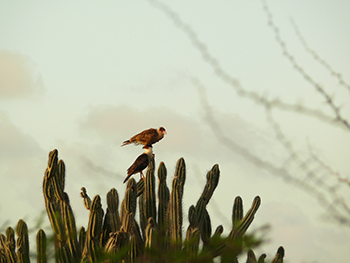
If carrion is the main food source of these birds the best place to observe them and photograph them is wherever there is a steady supply of dead animals. Of course these are the areas on the island which are also the most polluted as people do not only dump carcasses but also other garbage. Not very sanitary and not exactly the locations most tourist want to go. So once again we point you to an area where the chance of seeing Caracara’s is high and the amount of garbage is usually relatively low, and that is the road starting from the flamingo area at Sami Liber towards Bullenbaai. The main official landfill of the island is located in the vicinity of this road and this of course provides with plenty of carrion. Young birds tend to group together in the vicinity of the beach of Vaersenbaai (also known as Kokomo) and can be seen sitting on large columnar cacti, high rocks or trees. Or walking on the side of the road in search of roadkill.
Be aware of traffic when driving in search of this bird and always look in your hind mirror before breaking to avoid accidents. Try to take pictures from the car, and avoid stepping outside of the car. These birds are cool with cars but will get spooked by seeing people walking.

 Bird Watching Curaçao - HOME