
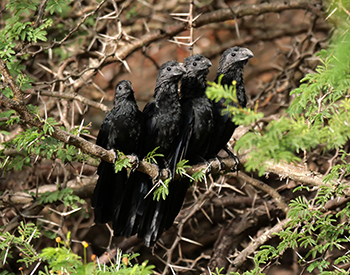
Photo by: Michelle Pors-da Costa Gomez
The first question we get from birders visiting the island of Curaçao is: ‘Can you recommend locations we can visit to spot birds?’ This question has many different answers. Curaçao might be relatively small in surface, but has an incredible variety of both native birds, migratory birds and new introductions whether by natural forces, or mankind, non-problematic or invasive. It all depends on what species you want to see exactly and how much time you have to spend searching for birds. In this series we introduce you to a variety of areas depending on the type of birds you want to see. With some tips and tricks and do’s and don’ts. This is the eight article in a series of 10!
A Cuckoo anyone…?
The Cuckoo family has a very bad reputation in the world, being seen as those birds that lay their eggs in other bird’s nests, leaving the chick rearing to the stepparents in question, which are often much smaller that Cuckoos in general. They are considered to be bad parents with their behaviour of brood parasitism. If we look at this behaviour from a human standpoint of course. The thing is that not all species in the Cuckoo family behave as such, it is behaviour which was made famous by the Common Cuckoo which can be spotted in e.g. Europe.
Groove-billed Ani
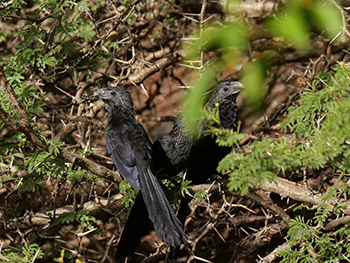
On Curaçao however we have a species which is a member of the Cuckoo family which displays a completely different breeding behaviour. They breed in breeding communities consisting of many females nesting together a rearing the chicks together. The species we are talking about is the Groove-billed Ani, a funky looking shiny black bird with a long tail and very large grooved bill which looks endearing and slight clumsy in the field. In Papiamentu they are called Chuchubi pretu.
However, they are phenomenal hunters that live together in groups and hunt together, often preparing ambushes in which a small part of the group flush out insects towards a certain location where the rest of the group will wait to catch them. Insects are their main food source, grasshoppers, butterflies, caterpillars and dragonflies are all on the list of eligible prey. Besides they do eat some fruit sometimes, large ants as well as small lizzards.
Where to spot a Groove-billed Ani

Ani’s love grassy open spaces aligned with thorny shrubs in which they can hide, oversee their hunting grounds and prepare for hunting their prey. Look for unused of less used sport fields on the island, or areas with low shrubs in the Christoffelpark. Golf courses are also a favorite amongst these and large groups can be found here, hunting on the grass, often together with grass mowers, which make sure insects are flushed. From the Golf Club house at the plantations house of Blue Bay for instance, you can see these birds hunting from the terrace. Do not go onto the golf course though, heavy fines will be applied for non-golfers if they access the golf course.

 Bird Watching Curaçao - HOME