
The first question we get from birders visiting the island of Curaçao is: ‘Can you recommend locations we can visit to spot birds?’ This question has many different answers. Curaçao might be relatively small in surface, but has an incredible variety of both native birds, migratory birds and new introductions whether by natural forces, or mankind, non-problematic or invasive. It all depends on what species you want to see exactly and how much time you have to spend searching for birds. In this series we introduce you to a variety of areas depending on the type of birds you want to see. With some tips and tricks and do’s and don’ts. This is the last article in a series of 10!
Just one (1) breeding warbler.
Open any bird book about the avifauna of Curaçao and you will find several pages filled with all kinds of warbler species that can theoretically be found on the island. Theoretically, because of all the illustrated species only one (1) is an actual native, breeding bird on the island. The rest are all migratory species, of which most only visit during a short period of time to replenish their fat reserves before going on to the next stop on their route toward their winter grounds. True, some individuals of some migratory species decide to stay over during the winter months and fly back to North America in spring for their breeding adventures. And some of those migratory species illustrated in the books do not always visit the island every year.
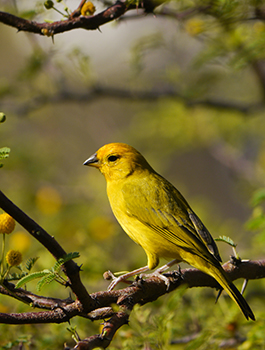
The one breeding warbler species we do have on the island is a literal ray of sunlight with its yellow colouring providing the common name: Yellow warbler. However the variation of Yellow warbler we do have on our island is also named the Golden warbler, with a distinguished colour pattern, individuals of the same species but different subspecies on other Caribbean island do not have.
Small
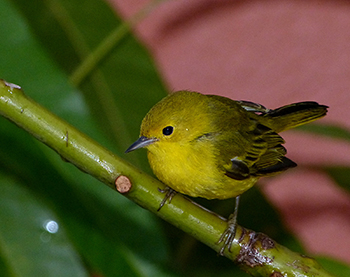
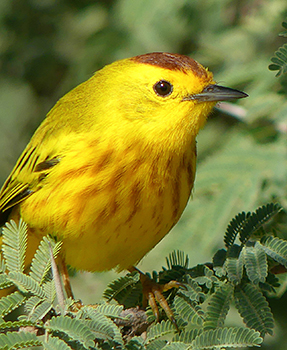
Yellow warblers are one of the smallest species of birds on the island of Curaçao besides the hummingbirds of course and only measure about 12 cm in length. Their warm yellow colouring is conspicuous combined with reddish brown stripes on the breast in both males and much lighter in females. The males also have a reddish brown cap on the top of their heads. This cap is responsible for the naming in Papiamentu which is is ‘Para di misa’ (which translates into ‘Church bird’) in English, as it closely resembles the skull caps worn by monks in the past. The remarkable part of the story is that the nominate species of Yellow warbler, from North America, is completely yellow and does have the reddish brown stripes on the breast in a lighter pattern in the males (not in the females), and no cap in males. There are many Yellow warbler subspecies in the Caribbean and Americas including the so called Mangrove warbler (which has a full reddish brown coloured head) and the South Caribbean subspecies which is called the Golden Warbler (scientific name: Setophaga petechia rufopileata). The one you can find on Curaçao.
Insect eaters
Warblers are mainly known as insect eaters, the reason why these birds never sit in one place for more than a second or two before hopping onto the next spot looking for ants, caterpillars, grasshoppers, moths and butterflies and also spiders. But often people do not realize that even these insect eating gems, often add on their diet with fruits, nectars and sometimes also pollen, which is rich in protein. The Yellow or Golden warbler is no exception and you can sea them in almost every habitat on the island, as long as there are enough insects to be found.
Where to find a Golden warbler
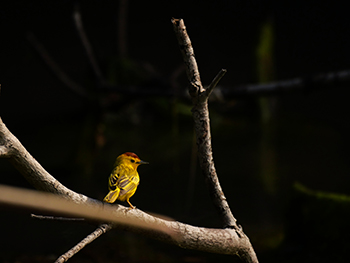
Yes, these birds can be found in almost every habitat on the island provided there are insects to hunt. But that doesn’t mean finding them is easy. Especially because they are so fast while hunting that often a golden yellow flash is all you see before the bird disappears in between the twigs. However, there are a couple of tips you can follow to increase your chances of a good sighting as well as possibilities for photographs.
- Find yourself an area with low shrubs that still have some leaves on them, such as Acacia shrubs of the famous Dividivi plants (that can still carry some leaves in the dry season as well). Now pick a spot from which you have a good view on the plants and train your patience, because it can take a while. Scan the shrubs with your binoculars until you see a yellow flash that is not a Bananaquit. Especially in the dry season it will be a little easier to get a good view as there are many openings in the foliage of the shrubs.
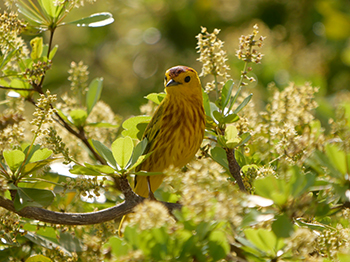
- If you like visiting beaches such as Daaibooi, Cas Abou and Porto Marie, keep a close eye on the so called sea-grape shrubs/trees often planted at the backside of the beach separating the parking places with the beach itself. Especially when these trees are flowering chances are very large that you will be seeing several of the Yellow warblers in these trees. Why? The pollen and nectar rich flowers attract massive numbers of small butterflies and especially ants and bees. This provides almost an ‘all you can eat’ restaurant to these birds and provides you with ample time to observe and photograph them.
Do not confuse the Golden warbler with the Saffron finch
Another yellow bird on the island is the Saffron Finch, as its name also indicates. However this seedeater is not only larger than the Yellow warbler, it is also a seed eater with a bill which suits this life style. The bill is very heavy, triangular in shape, with a yellow lower beak. In comparison the bill of a Yellow warbler is a delicate, sharp thin and pointy and completely black. Saffron finches are less golden in their colouring and are conspicuous with a bright orange head colour.

 Bird Watching Curaçao - HOME