
Every bird migration on the island is one filled with expectations; what species will be seen this year and where. And this year is no exception. Local birders are getting better and better in searching the interesting locations as well as in finding the smallest of birds. And photographing them of course. And besides these discoveries visiting birders with an eye for the unexpected also find interesting species.

Many migratory bird species are very regular visitors to the island, visiting us every year around approximately the same time, whilst on their migration route south. Think of Ospreys, Blackpoll warblers and Yellow-billed Cuckoos (see this post @Yellow-billed Cuckoos). There are quite a few species of migratory birds that are considered infrequent and even rare visitors as their migration routes usually don’t follow a line in which our island is featured as a potential stop over. The reasons we can occasionally see them anyway, are still not fully understood, as climatological and weather circumstances may play a role as well as individual choices of birds themselves. One of such species is the Rose-breasted Grosbeak, registered as an irregular visitor from North America with an unpredictable occurrence (Birds of Aruba, Curaçao and Bonaire by de Boer, Newton and Restall). Marine Biologist and birder Lucas Bernier, who visited our island mid October, did encounter one of these rare birds while visiting the area of Daaibooi on October 18th.
Rose-breasted grosbeak
Rose-breasted grosbeaks are North American birds that breed in forests in the North-eastern United States and Canada where they will occur in both secondary forests, parks and gardens. Their overwintering grounds lay in forested areas and also half open wild locations in South and Central America such as Colombia. These birds are omnivorous as they eat both insects, seeds and fruits.
Male Rose-breasted Grosbeaks are very conspicuous in their colouring with a striking Black back with white striped, a white belly and bright rose-coloured breast. Females however, as in most bird species, are far less conspicuously coloured with dark brown ad greyish colours, white patches on the wings and a white eyebrow stripe.
Exhaustion
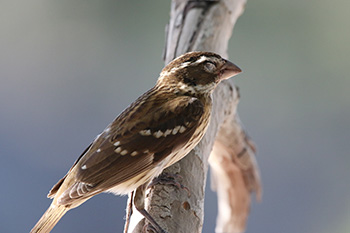
Bernier, who spotted the bird at Daaibooi on the 18th of October, noticed that the bird was completely exhausted, resting wherever it could, first on a tree then on the sand. After which it moved away about an hour later.
It is very likely that the bird in question had just arrived on the island when it was spotted at Daaibooi after a long journey which started in North America. These and many other small passerines are having a very difficult time in the last couple of years as changes in climatological circumstances influence the food supply before they leave their breeding grounds. We see the same situation with swallows as well, with alarming mortality rates of these migratory birds during their migration.
We do hope that this bird survived the ordeal, managed to find food and water to replenish its reserves to continue the journey to South America.
English: Rose-breasted Grosbeak
Dutch: Roodborstkardinaal
Papiamentu: Pik grandi pechu ros (?)
Scientific: Pheucticus ludovicianus
PHOTO’S BY: Lucas Bernier – See more of his photos on Instagram: @lucanimalis

 Bird Watching Curaçao - HOME