
Every bird migration on the island is one filled with expectations; what species will be seen this year and where. And this year is no exception. Local birders are getting better and better in searching the interesting locations as well as in finding the smallest of birds. And photographing them of course. This is the story of how nature lover and bird enthusiast Nelly Rigot discovered a duck species not seen on the island since the 70’s.
When you have an inquisitive nature and like to go outside to enjoy the natural surroundings, birding can be a very exciting and also humbling experience. When experiencing the behaviour of birds, even the ones you see everyday, and learn about the skills for survival, interactions with other birds from the same or other species, they way they communicate and the way they share the available space with you, at a certain point in time you can become addicted to watching and especially observing birds. And by going back to your favourite spots and locations over and over again you will learn the surroundings like the back of your hand and also learn to identify the ‘usual’ bird suspects of the area. And once you have that skill, your senses will be overloaded when you suddenly discover something you have never seen before, provoking a series of euphoric adrenaline-filled moments in which you try to photograph the unusual sighting with hands that are shaking, while your brain is trying to go through the rows of possibilities you are looking at. It is something that I have been through multiple times and I can only guess at the excitement birder and all out nature observer Nelly Rigot was feeling when she visited the area of Muizenberg Dam on November 15th 2023.
This area is also a Ramsar-site and protected by law. It is a huge dam, constructed in the past to supply the Shell refinery with fresh water for its oil refining process, as ground water has always been scarce on the island. It does not contain water throughout the year and often does not have a drop of water in it for years. However some heavy rain showers at the end of 2022 and also in the beginning of 2023 made sure that the dam contained water for months until deep into the last month of August, providing a perfect habitat for thousands of water birds including Caribbean coots, White-cheeked pintails and tri-coloured herons. Mid August, with the first migratory species already arriving on the shores of the island the area provided a perfect place for them to rest and feed, with hundreds of birds including short-billed dowitchers, least and semi-palmated sandpipers, greater and lesser yellowlegs and much more. Then, the dam dried up, only to be filled again in October. Just in time for the masses of migratory birds which are now accumulating in the area.

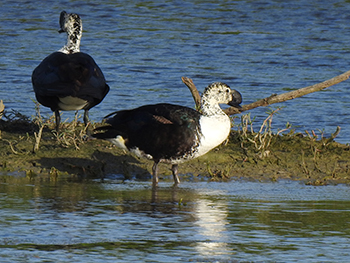
On November 15th Nelly was visiting the area, and taking a lot of pictures of the birds swimming and roaming in the area, when she suddenly saw 3 very large weirdly coloured ducks with peculiar beaks. I can only imagine what thought went through her head when she took the pictures included in this article. She had the first sighting of Comb Ducks on Curaçao, in 52 years. These birds were seen only once on the island in the area of Malpais on the 30th of March 1971 by observer W Bokma, who filmed the encounter with 9 individuals of these ducks. Since that moment no other records have been made of sighting of these birds.
Comb ducks are large, females can be 55 cm and males 75 cm in length. Males can be disntiguished easily by the huge black comb at the base of the bill, which the females don’t have. They are birds that live in South America, especially in Brazil and Paraguay and can occasionally be found on Trinidad. They breed in lakes and fresh water marshes and feed on vegetation and some times small fish and invertebrates.
English: Comb duck
Dutch: Knobbeleend
Papiamentu: Patu bòlòbònchi
Scientific: Sarkidiornis sylvicola

 Bird Watching Curaçao - HOME