
Every year the list of new species of birds recorded on Curaçao grows, thanks to the increase of people really looking around and actively identifying bird species. The story of the seedeaters is one that started with an incredible observation by a visitor to the island which led to searching endeavours by the team of local super bird searchers that are active on the island. This is the story of how the Lined-seedeater and the Ruddy-breasted seedeater were recorded for Curaçao.
The first record came in April 2024
Bird Watching Curaçao received an email on April 23rd 2024 by Phil Tizzard stating that during his brief visit to the island he discovered an male Ruddy-breasted Seedeater earlier that month on the 15th of April at Shete Boka NP. Unfortunately he did not get a photo but was so familiar and experienced identifying the species that he was very certain of his observation, hence going into the history books with the first ever record of the species on Curaçao. He suggested that local birder go out to try and photograph the bird to strengthen the record of the species. And that is exactly what happened. A team of local birders went out several times in the area to try and locate the bird. Without tangible seedeater results.
July- Another lifer and first record for Curaçao: The Lined Seedeater
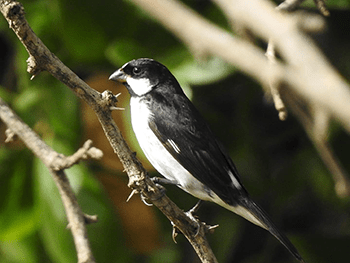
Photo by: Nelly Rigot.
On the 9th of July master birder Rob Wellens was in the area of Westpunt when he found another first seedeater record for Curaçao: the Lined Seedeater, a beautiful black and white bird. This bird, also from South America has never before been recorded for the island. And with its presence the hopes for finding the Ruddy-breasted Seedeater increased significantly. The sighting of the Lined Seedeater came right after the have flood rains of the month May which caused havoc in the area of Banda Bou with a lot of damage to property and also the filling up of many dams and gullies, providing a green habitat with loads of food for a wide array of bird species. It apparently provided a perfect feeding ground for the Lined Seedeater.
July 11th 2024 – The much anticipated Ruddy-breasted Seedeater
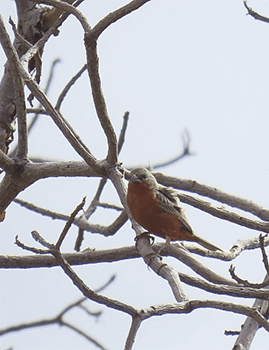
Photo by Rob Wellens.
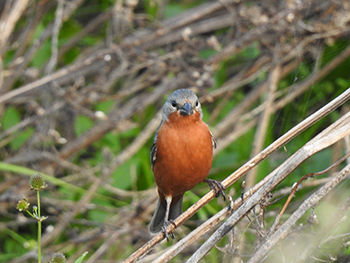
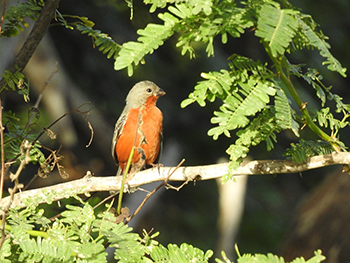
Of course, after spotting the Lined Seedeater, birders Rob, Henriette de Vries and Nelly Rigot went back to the area to see if they could locate anything else exciting and bam there it was; the elusive Ruddy-breasted Seedeater presented itself in all its glory showing off its bright coloration and proving on photo once and for all that is was indeed present on the island. The first record for the moth of April of this year by Mr. Tizzard stands firm, and with the second record not so far from where the species was first seen, it is now proven beyond any doubt that the species indeed visited the island.
Ecology of these Seedeaters: the Lined Seedeater
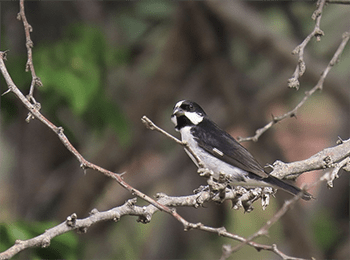
Photo by Rob Wellens.
The Lined Seedeater species (Sporophila lineola) is found in many countries in South America including Argentina, Brazil, French Guyana, Guyana, Suriname and Venezuela where it lives in tropical shrubland and agricultural areas where it is moist.
The bird looks like a finch and have the same form of bill. Females can be mistaken for the local Black-faced grassquits in coloration. Males are striking in black and white.
The breeding season of this species in the southern region of South American starts in November and from May onwards, when winter starts there, they migrate to Northern South America and might have potentially arrived on Curaçao and stayed thanks to the food supply provided by the torrential rains in May.
Ecology of these Seedeaters: The Ruddy-breasted Seedeater

Photo by Nelly Rigot
Ruddy-breasted Seedeaters (Sporophila minuta) live in Central and South America from Colombia to Mexico and also live in Trinidad and Tobago and Venezuela. They live in areas that can be identified as savanna like as well as agricultural grassland. Like the Lined Seedeater they look like finches. There is not much known about their migration patterns other than that they tend to live in flocks sometimes together with other seedeater species.



 Bird Watching Curaçao - HOME