
Bird watching on Curaçao is a surprise throughout the year. The island may be small (444 square kilometers or +/- 171.4 square miles), but has many small habitats spread out from the east to the west. Even in the inner city of Unesco World Heritage Willemstad, there are many areas where a bird can hide, eat, nest or just rest. Which makes every corner of the island potentially interesting for birders.
March is known as the month in which the dry season usually breaks through in earnest on the island. Trees and shrubs discard their leaves, creating an almost fall-like ambiance in nature. Most dams and other waterways have all dried up or have some remnants of water providing refreshments and food to birds and other animals. All in all the circumstances in the wild make sure that gardens are flooded once again with all kinds of birds searching for food, water and shelter where plants are watered. There are still some migratory bird species overwintering on the island and in the process of preparing for their breeding season as this season in the Northern hemisphere is slowly starting up. These feathered guests will fly back to e.g. North America to breed.
We also have the chance to see some early migratory birds in places where food and water is provided in gardens and parks. And of course in the scarce locations where water is still present in nature. Besides the native birds we have on the island year round of course. This is in short what you may encounter in nature or in the garden in the month of March on Curaçao.
Early migratory birds: Rose-breasted grosbeaks
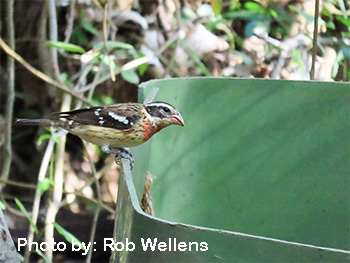
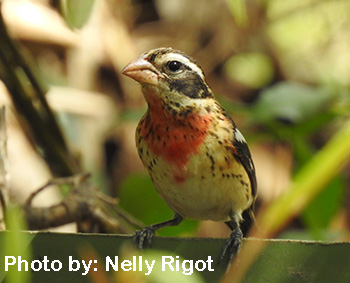
Rose-breasted grosbeaks are North American birds that breed in forests in the northeastern United States and Canada, where they are found in secondary forests, parks, and gardens. Their wintering grounds are in wooded areas and also semi-open wild sites in South and Central America, such as Colombia. These birds are omnivorous, eating insects, seeds, and fruit. In their breeding grounds, these birds often visit bird feeders, where they eat sunflower seeds and peanuts. Male Rose-breasted grosbeaks are very striking in their coloration, with a striking black back with white stripes, a white belly, and a bright pink breast. Females, however, as with most bird species, are much less strikingly colored with dark brown and grayish colors, white wing patches, and a white supercilium stripe. The bird in the photos was photographed by birders Rob Wellens and Nelly Rigot in Hofi Mango in March of this year (2025). This is a young immature male whose black head has not yet fully developed. The animal can be recognized as a young male by the pink spots. Females do not have these spots.
Wintering birds: Black and white warbler
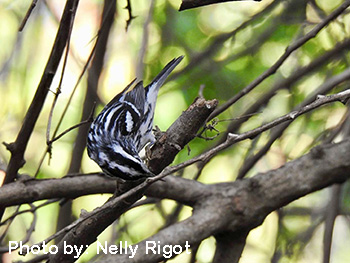
Now that the birds of the Northern hemisphere that breed in North America are preparing to make the journey back to their breeding grounds, many of them are transforming into their breeding plumage. One of these species that has been overwintering is the Black an white warbler, a striking patterned and coloured small warbler that never sits still and is always on the move searching for insects. Look for this bird in wooded areas on the island and stand still to observe movements in the middle and top sections of the trees.
Love is in the air
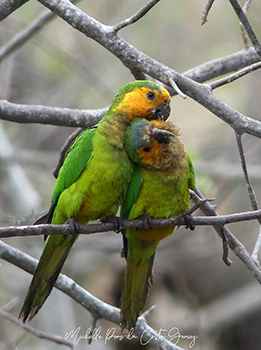
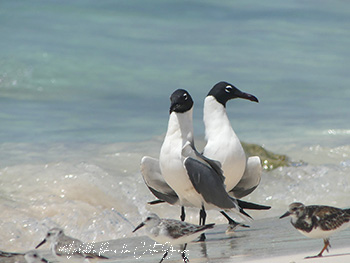
Even if the dry season is hitting hard, there are species that choose to reproduce in these kinds of circumstances. The Brown-throated parakeer or Prikichi is one of them. This endemic subspecies is now making out and flirting in this period in order to jointly build a nest in, among other things, termite nests. If you are lucky enough to find a couple in love, you can observe the entire courtship ritual with all the flirting, including the mating. It is not strange that these birds are starting to produce their offspring in this period. Now that it is getting drier, the columnar cacti are blooming in optima forma and producing fruit, an important food source for our native parakeets. In addition to the parakeet breeding season, it is also almost time for seabirds such as terns and Laughing gulls to start their breeding season, as they do every year from March to July/August. From the end of January, the numbers of Royal terns and Laughing gulls have slowly increased. Suddenly, the Sandwich terns and American Least terns will also appear on the scene after being absent for months. Slowly but surely, the birds will get their breeding plumage and pair bonding will begin. Like the Laughing gull couple in the photo, who not only have their characteristic dark brown heads but also dark gray wings and a reddish haze over their beaks. The birds will conquer each other by means of a complicated dance ritual in order to be able to produce a new generation together.

 Bird Watching Curaçao - HOME