
Bird watching on Curaçao is a surprise throughout the year. The island may be small (444 square kilometers or +/- 171.4 square miles), but has many small habitats spread out from the east to the west. Even in the inner city of Unesco World Heritage Willemstad, there are many areas where a bird can hide, eat, nest or just rest. Which makes every corner of the island potentially interesting for birders.
Young birds


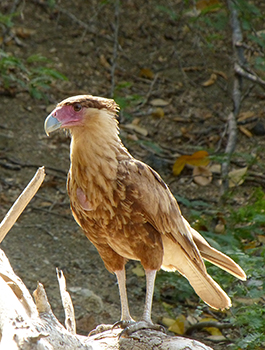
The dry season is particularly suitable for breeding for the Crested Caracara. Due to a lack of food and water, prey animals become weaker and are much easier to catch. There are also fewer hiding places, making them easier to find. It is therefore not surprising that you encounter young Crested Caracaras in many places in the month of May, sometimes even in the midde of the inner city.
Birds, such as the Saffron Finch, which can mainly be found in the vicinity of human habitation all year round, can be found breeding all year round. There is always food or water to be found in gardens, so these birds do not have to limit themselves to the dry and wet periods.
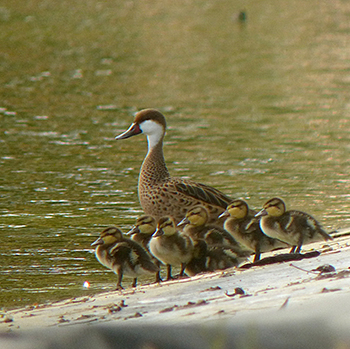
In places where water remains for a long time, such as in the ponds of water treatment plants or golf courses, or the dams that are full after a heavy rain shower, you will quickly find an increase in the number of water birds. And if there is enough food to be found in the water, they will also start to reproduce, such as this White-cheeked pintail duck with young. From May onwards, the older and stronger offspring of the Caribbean flamingos, which hatched on Bonaire earlier this year, will fly with their parents to Curacao to look for food. From this moment onwards, you will often encounter alost colorless flamingos in the salt pans and Saliñas.
Seabird breeding season in full swing
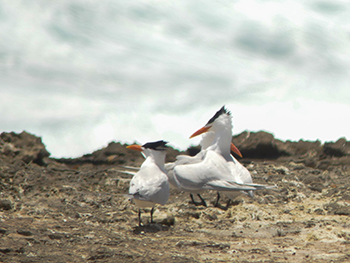
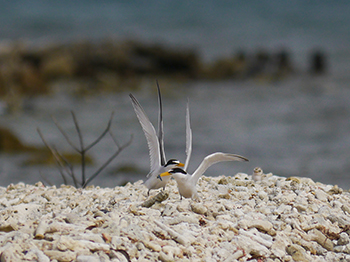
Last month there was already a whole article about breeding seabirds on the coast on this website (read it here). The seabird breeding season is now in full swing and it is noticeable because of the aggressive behaviour of adult birds, their protection of breeding locations, the flying back and forth with fish and also the strengthening of the mutual bond between the parents by courting. The photos show a Royal Tern performing a courtship step and an Least Tern bringing a fish for its partner.
Special visit
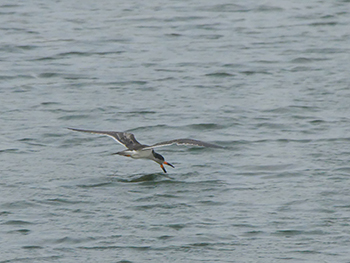
While it was usually the months of June, July and August that the special Black skimmers could be seen on our island, nowadays the month of May is also suitable for these birds to show themselves. These strange birds can be seen along the coast or in the salt pans of Jan Thiel, for example. They are coloured in black and white and have a strangely shaped beak. The bottom of the beak is longer than the top and that makes it very suitable for fishing at the waters surface. They open their beak and skim just over the water surface while the under part of the beak is under water. In this way they can scoop up prey.
Sargassum

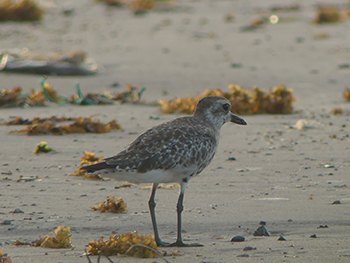
The island is increasingly affected by the influx of sargassum which appears to get heftier every year. Especially inner bays on the north side of the island are vulernable to the influx as the tide bring mass amounts of the algae in, as such clogging these areas completely. Sea turtles and other sea animals get trapped and often die, if not rescued, Local organization Sea Turtle Conservation Curaçao has been working non stop on saving as many turtles as possible. (Take a look at their Facebook page for information on how to help!)
Small crustaceans and fish that get stuck are an easy meal to many herons, egrets, and smaller shore birds. However the longer the sargassum stays in the inlets, the less healthy the decaying algae will make the surroundings. Resulting in a first increase in birds coming in for the bonanza, and an area devoid of birds later on.

 Bird Watching Curaçao - HOME