
Bird watching on Curaçao is a surprise throughout the year. The island may be small (444 square kilometers or +/- 171.4 square miles), but has many small habitats spread out from the east to the west. Even in the inner city of Unesco World Heritage Willemstad, there are many areas where a bird can hide, eat, nest or just rest. Which makes every corner of the island potentially interesting for birders.
Pelican flying lessons
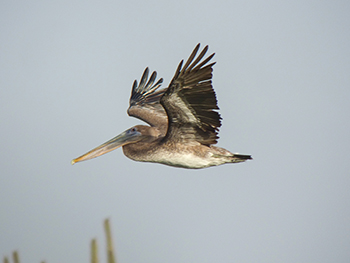
From June onwards, you will see groups of Brown pelicans sitting together along the coast in various places, consisting of a few adults and a whole bunch of young birds. These young birds, born and raised elsewhere in the Caribbean, find the ideal conditions on our coastline to build up their flying experience and also to practice finding food and especially catching it. Along various places, mainly on the northern side of our island, there are so-called ‘training centers’ for these young birds where they extensively practice flying with strong winds and waves. A pleasure to watch.
Dead animals a feast for the Warawara
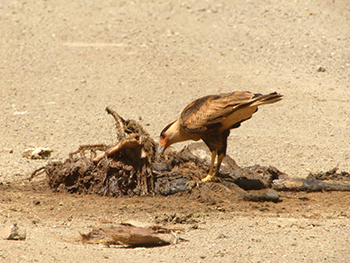
The young Crested Caracaras have left the nest and sometimes still have to search for food together with their parents, but all too often also alone. The young animals group together in larger groups that in some cases can reach a size of 25 animals or more. Clever, because together they can find much more food than alone. Because our human islanders have become so easy at throwing dead dogs, goats and sometimes even donkeys and horses into the mondi, the Crested caracaras (Warawara in Papiamentu) find this a grateful source of food. Especially the young birds, who have not yet mastered the art of hunting live prey, gratefully make use of this free food service.
Young American kestrels fly out
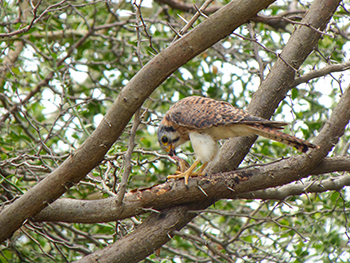
The smallest bird of prey on our island, the Kinikini or American kestrel, has also produced young that will have to survive on their own from now on. The young birds are not yet very good at hunting and if they do succeed, they will fight off any form of competition, including a brother or sister who is still nearby and thinks they can also have a bite. The photo shows a young male kinikini who is happily devouring a lizard.
Cacti are the salvation
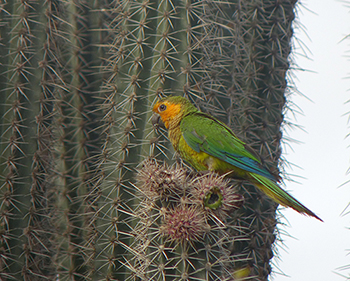
The juicy, sometimes even still green, fruits of the various columnar cacti species on the island are the salvation for various species of birds, reptiles, mammals and even insects. Now that there is little else to eat, these sugar and therefore energy-rich fruits are the food to eat for these animals. However, the intention is that the ripe cactus fruits are eaten, because they contain the well-developed seeds that contain sufficient germination power. However, because there are fewer and fewer natural places, and therefore also less and less food to be found for, among others, our endemic subspecies of Brown-throated parakeet, they devour the still green cactus fruits, in order to survive. Not only are these much less nutritious for the animals, it is also problematic for the cacti because the seeds in the fruits are not ready to germinate properly. And that means much less reproductive success. It is also during this period that you will find more and more fruit-eating birds in the gardens where there are fruit trees with mangoes, kenepas and other fruits. The animals are hungry, and humans are destroying more and more of their natural environment.

 Bird Watching Curaçao - HOME