
Bird watching on Curaçao is a surprise throughout the year. The island may be small (444 square kilometers or +/- 171.4 square miles), but has many small habitats spread out from the east to the west. Even in the inner city of Unesco World Heritage Willemstad, there are many areas where a bird can hide, eat, nest or just rest. Which makes every corner of the island potentially interesting for birders.
October is a true transition month. While tropical depressions sometimes bring occasional rain showers as early as August and September, October is known as the month where the rainy season begins, more or less halfway through. A season with long periods of drought one year, and so much rain the next that some dams are already flooding. In short, a transition month, where the hot, dry season is effectively exchanged for a potential period with a wide variety of flowering plants, an explosion of insects, and very interesting birds from other regions, some of which are very rare and only seen very occasionally.
Spotting masses of Ospreys
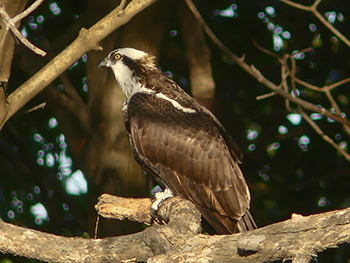
It’s as if the birds have marked it on their calendars: in early October, the Ospreys that breed in North America begin their migration south. One of the routes they use is the so-called Caribbean route, which also includes the ABC Islands. Although the birds don’t live or migrate in flocks, it’s quite striking to see them arrive en masse on our islands. One day you’ll have to struggle to find one that has spent the entire year here (usually the young birds that aren’t yet sexually mature), and the next, you suddenly see them everywhere; at Koredor, Westpunt, Jan Thiel, Klein Curaçao, Santa Cruz, Nieuwe Havenweg, Christoffel Park, Shete Boka, Playa Kanoa, Jan Kok, and so on. The birds find our waters an excellent fishing spot to catch and consume prey, thus rebuilding their energy and fat reserves. Most of these birds stay for only a few days to a few weeks, while a small group stays longer and overwinters on the island. Young birds that are not yet sexually mature because they hatched this year often decide it’s better to stay here all year, since returning to their breeding grounds in spring isn’t yet an option.
Young Warawaras Everywhere
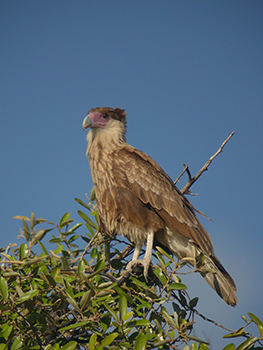
The timing of the nesting of the Crested Caracaras depends somewhat on the start of the dry season. Since these birds enjoy scavenging, the dry season, when many other animals die, is the ideal time for nesting. This is especially true for the period from July to August to September, when it is generally dry enough to hunt live prey in the then bare undergrowth, in addition to scavenging. In October, it seems as if young Warawaras are emerging from the undergrowth everywhere. In most cases, these are animals chased away by their parents because they are old enough to forage for themselves. As this isn’t always a smooth process, the animals often come to places where people throw a lot of trash, as there’s always something edible to be found, such as a dead dog or cat. In some locations on the island, the young Warawaras group together and form real packs of sometimes nearly 25 animals or more. Together they scour the mondi for food, and together they can pose a real risk to larger animals. Incidentally, many of the young warawaras will not survive. Even with these birds of prey, the law of the strongest and the smartest applies.
Wilson’s Snipes
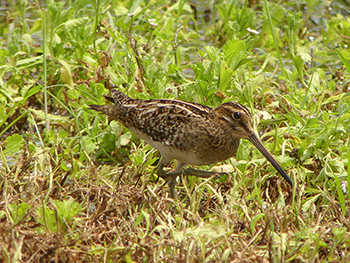
Wilson’s snipe are migratory birds that can only be seen en masse on the island for a very limited period, primarily in wet areas that remain humid for a longer period of time. These include marshy areas near mangroves, ponds on golf courses, the cisterns of water treatment plants, and dams and gullies. Wilson’s snipes can be found in both fresh and salt water areas, although they are more common near freshwater puddles.
These birds are not only very shy, but also perfectly camouflaged against the grasses they prefer to stand in. Therefore, you usually don’t see them until you’re practically on top of them, when they take flight with a characteristic call and land elsewhere. Most individuals will fly on to South America after a while, but a few decide to overwinter on the island.
Flamingo Dance Rituals
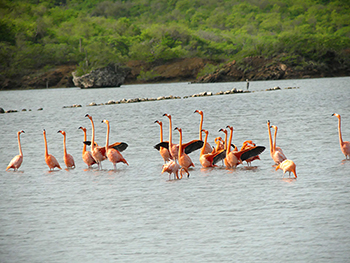
October is the perfect time to observe the fascinating courtship dances of the popular American (or Caribbean) flamingo. The breeding season is upon us, and the males will do their utmost to impress the females and form a lasting pair. Together, they will build a nest (sadly no longer in Curaçao) and raise the young.
The flamingo dance is a beautiful sight to behold. You usually have to be there in the early morning or late afternoon, when the flamingos are asleep. The males group together and first stride back and forth through the water with their necks extended. Then, with their necks extended, they open their wings, clearly showing the contrasting black part. After this, they make a kind of bow to the females. This pattern continues quietly for a while. As an observer, be careful not to get too close or disturb the animals.
The Yellow-billed Cuckoos fall from the Sky
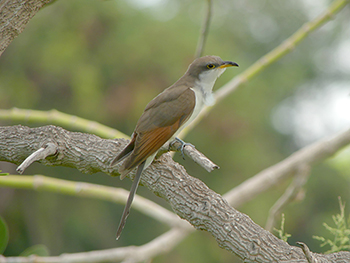
The last weeks of October are cuckoo weeks every year. All over the island, you’ll find the exhausted birds on the ground, along or on the road, and in other, often dangerous locations. The Yellow-billed cuckoo, a North American cuckoo species (which, incidentally, doesn’t engage in nest parasitism on the same scale as the European cuckoo and doesn’t breed on our island) is exhausted when it finally reaches the islands and literally falls from the sky from fatigue and malnutrition. Many are then unfortunately run over or caught by dogs or cats. The best course of action is to gently pick up the birds with a small towel and let them rest in a safe, quiet place with a shallow bowl of water nearby. In most cases, the birds will leave on their own after a short period of time. If the animal continues to be weak, contact a veterinarian as soon as possible.
Special encounters this month up till now!
Glossy ibis
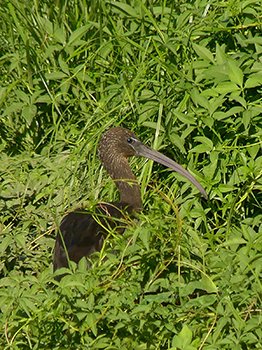
Every now and then we’re lucky enough to spot ibises on the island, and last week the Glossy Ibis, or Black Ibis, popped over to Curaçao. The species is found worldwide and can also be found in the Caribbean and South America, and it’s highly likely that the birds from the mainland occasionally pop over. When a Glossy Ibis does appear on the island, they generally don’t stay for very long, usually just a few weeks. But they always stay in an area with water they can wade through to forage for food with their long beaks. This beautiful bird was also spotted at the Muizenberg Dam.
Buff-breasted sandpipers
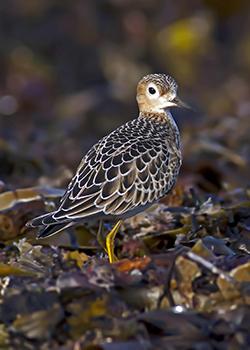
Local birdwatchers are already fully immersed in the migratory bird season, and the beautiful sightings are already starting to trickle in. Although the dams aren’t full of water, there are sufficient ponds in certain areas, along with plenty of food, to provide migratory birds with a good meal and much-needed rest. Several species of wading birds are frequent visitors and even winter visitors to our island. But every now and then, there are some remarkable sightings. Like last week’s discovery of the so-called Buff-breasted Sandpiper (Calidris subruficollis). This bird, with bright yellow legs, has a reddish-brown colour and a broad chest, and at first glance resembles a large pigeon. They grow to about 20 centimetres long. The birds breed in the Arctic tundra of North America and have therefore completed an incredibly long journey before they even arrive in Curaçao. And then their journey isn’t over yet, as they continue to the south-eastern part of South America for the winter.
These birds are not regular visitors to the island and are a rare species. Last week, several of these birds were seen near the Muizenberg Dam.

 Bird Watching Curaçao - HOME
One thought on “Bird watching on Curaçao in October”