
Bird watching on Curaçao is a surprise throughout the year. The island may be small (444 square kilometers or +/- 171.4 square miles), but has many small habitats spread out from the east to the west. Even in the inner city of Unesco World Heritage Willemstad, there are many areas where a bird can hide, eat, nest or just rest. Which makes every corner of the island potentially interesting for birders.
November usually marks the end of the masses of migratory birds passing through the many habitats of the island, but that doesn’t mean there will be no surprises left. Time has told us that the month of November sometimes provides with incredible sightings of rare species and even new species to the island. It might pay off to visit and revisit certain areas on the island regularly to keep track of the bird diversity there. Think of areas such as the RAMSAR area of Muizenberg dam. This dam doesn’t fill up completely every year, it depends on the amount of rain falling in the rainy season. Usually the area contains water puddles that attract a lot of terrestrial and shorebirds. If rainfall is more extensive in the direct area, chances are that the dam will fill up completely transforming into a fresh water pond that also attracts a variety of waterbirds. The same counts for other dams and gullies on the island.
Territorial Fights of White-Tailed Hawks
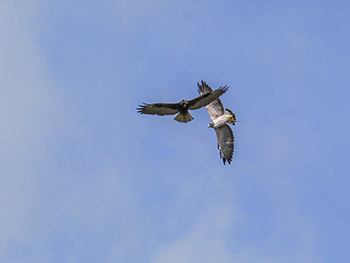
The White-Tailed Hawk (Geranoaetus albicaudatus) is one of the rarest breeding birds in our airspace and is becoming increasingly rare on Curaçao due to habitat destruction. During these last months of the year, territorial fights will be more common, primarily between adults and young birds seeking their own territory. The parents will actively chase off their own offspring, which are already self-sufficient, out of the territory to create enough space for the next brood. This is essential, as the territory must provide sufficient food to feed the new nest. In areas where these birds occur, it’s important to keep a close eye out for these territorial fights while hiking; it’s definitely worth taking the time. A live-action documentary.
Calling loudly with their characteristic high-pitched screeches, the birds will circle each other and stage mock attacks. Usually, it’s the adult bird, recognizable by its dark head and white belly, that performs the mock attack on the younger bird, which is completely dark. If this doesn’t impress the young bird enough to actually chase it away, the mock attacks can escalate into real attacks, with the attacker using its feet and beak to try and overpower the other. If this succeeds, and the young bird flies away, the fight is over. If this doesn’t work, the fight will continue until one of the two gives up. If it’s the adult bird, the territory will be taken over by the younger bird, and the adult will likely die.
Incidentally, it’s not always the bird’s own offspring that tries to take over the parents’ territory. Usually, it’s young birds from other pairs searching for a spot for themselves, thus causing the fights.
Incidentally, the adult bird in the photo has just caught prey. A lizard is clenched in the bird’s talons.
Special Bird Visitors
Most of the autumn migration, when thousands of birds from North America fly to the warm south and sometimes visit the island, is behind us. But November is ideal for the arrival of ducks. They are often the last to arrive. And even here, most only stay for a few days and then move on. Only a few remain on the island for the winter. Besides ducks like the Ring-necked Duck other bird species can also be found such as the Prothonotary warbler and the fastest bird on Earth; the Peregrine falcon.
The Peregrine Falcon or Falco peregrinus
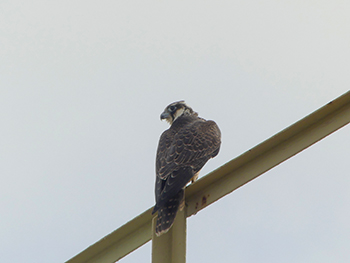
The fastest bird in the world is the Peregrine Falcon, and this beautiful species can also be found on Curaçao, primarily during the winter months. Recognizable by its streamlined wings and extremely fast flight. They are especially spotted in places where parrots and parakeets gather to roost, or in places where many (city) pigeons are found. These are ideal hunting grounds for these magnificent animals.
The Prothonotary Warbler or Protonotaria citrea
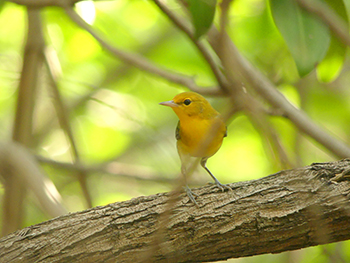
Fast and shy, the perfect combination for almost never being able to capture this species in a photo. These animals love swampy, marshy areas, and mangrove swamps are a favourite. You’d almost think their bright yellow colouring would go unnoticed, but it’s apparently the perfect camouflage.
Ring-billed Duck or Aythya collaris

In autumn and winter, these ducks are often quite inconspicuous, but they can be recognized by the ring around their bill and a much less visible, lighter-coloured ring around their neck. The birds are native to North America, where they live on freshwater lakes and ponds. They aren’t found on Curaçao every year, and when they are, they’re usually in small numbers.
The Swainson’s trush or Catharus ustulatus
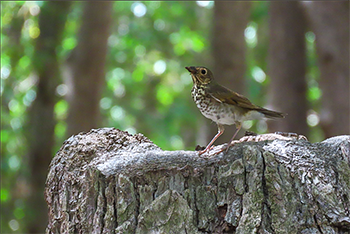
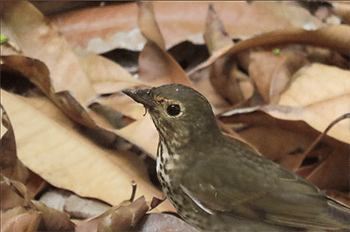
At the end of October 2023 local birder Rob Wellens registered the 3rd record for this very rare migratory species on the island of Klein Curaçao. It was exiting find with only 2 former records in total starting with the first sighting of one bird at Grote Knip on the 23rd of October 1951, observed bij K. H. Voous, and one bird found dead in Willemstad on April 23rd 1960 seen by B. de Jong. Between 1960 and 2023 no other specimens were found on the island of Curaçao making this sighting in October 2023 the first in 63 years. Now there is a 4th record of the Swainson’s Trush for Curaçao, this time recorded at Hofi Mango in Bandabou. The first time seen at this location: the end of October.
Multiple local birders have now managed to get photos and videos of the bird in question on multiple days. Photos in this post by local birder and photographer Rob Wellens.

 Bird Watching Curaçao - HOME
One thought on “Bird watching on Curaçao in November”