
Reposted from Caribbean Footprint Magazine: https://caribbeanfootprint.com/world-wetland-day-february-2/
Every year on February 2nd, the world pauses to reflect on wetlands, (periodically) wet areas of great value to nature and humanity. World Wetlands Day, as it is known, marks the date of the adoption of the Convention on Wetlands on February 2nd, 1971, in the Iranian city of Ramsar on the Caspian Sea coast. Each year, the organization behind Ramsar sets a theme, and for 2026, that theme is “Wetlands and traditional knowledge: celebrating cultural heritage.”
Wetlands and traditional knowledge: celebrating cultural heritage
As stated in the accompanying letter from the Secretary-General of the Convention on Wetlands, Dr. Musonda Mumba, the global campaign highlights the timeless role of traditional knowledge in sustaining wetland ecosystems and preserving cultural identity.
“People have coexisted with wetlands since prehistory, making use of their beneficial services while averting unintended consequences. Over time, a valuable depth of traditional knowledge has been deduced, shared and has subsequently evolved. Three fundamental messages guide this year’s campaign communications. We invite you to adapt them for your particular area and to share them widely to encourage participation in World Wetlands Day 2026.
- Wetlands are essential ecosystems that sustain rich biodiversity and also serve as cradles of cultural heritage and living traditions, particularly for Indigenous Peoples and local communities.
- Integrating traditional knowledge into conservation strategies enhances wetland protection and fosters inclusive, community-based approaches that recognise and respect longstanding ecological wisdom.
- The degradation of wetlands undermines human wellbeing, impacts human rights, and erodes traditional knowledge systems. Immediate and scaled-up action is critical to safeguard cultural heritage and to sustain the traditional knowledge systems that have long protected these highly productive ecosystems.”
(also see Dr Musonda Mumba Statement for World Wetlands Day 2026.pdf )
Under Pressure
Many wetlands are located near cities and other urban areas, putting them under enormous pressure from humanity’s increasing drive for expansion. They are being filled in, flattened, filled in, and built over. This is not wise, considering that these areas are important for reducing flooding, filtering runoff (including rainwater), improving air quality, and providing recreational opportunities. They also provide income for fishermen and tourists.
Aruba, Bonaire, and Curaçao have several RAMSAR wetland areas, but many of these areas are NOT protected as they should be, because of lack of funding and a lack of sense of urgency in especially governments. NGOs charged with protecting the areas are left without a well-formed local legal framework, lack of funding, insufficient capacity and political unwillingness to take action against threats.
Pollution, unregulated recreation, land reclamation, destruction, hunting, and more threats severely impact these areas.
Ramsar sites in Aruba
Several nature reserves on Aruba have been officially designated as protected wetlands, including Spaans Lagoen (1980), and as of 2023, also areas known as Western Wetlands (392 hectares), West Point (2,185 hectares), South Coast (3,975 hectares), and East Point (7,597 hectares), plus an expansion of the protected area in Spaans Lagoen (currently 259 hectares).
Ramsar sites on Bonaire
The four (4) Ramsar sites designated for Bonaire have held this designation since 1980 and are actively managed as nature reserves. These are Klein Bonaire (1,295 hectares), Pekelmeer (1,612 hectares), Washington-Slagbaai (5,853 hectares), and Lac-baai (1,550 hectares).
Ramsar sites in Curaçao
Curaçao has a total of five Ramsar sites, the most recent of which was designated in 2018. This concerns Klein Curaçao (248.5 hectares). In addition, four other areas were designated as Ramsar sites in 2013: Northwest Curaçao (2,442 hectares), Muizenberg Dam (65 hectares), Rif St. Marie (667 hectares), and Malpais/St. Michiel (1,100 hectares).
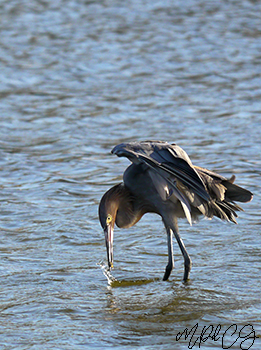
In Curaçao, the St. Michiel saliña is also part of one of these RAMSAR sites. It’s a popular spot for flamingo and other bird watching, hiking, and cycling, and a haven for wildlife. But it’s under severe pressure daily. Garbage dumping in the area, quad bikes driving into bird roosts, walkers with dogs allowing their dogs to chase birds, and even the presence of kitesurfers within seabird breeding grounds are just some of the problems in this RAMSAR site. Protective measures, with effective enforcement, are urgently needed. In the photo an immature Reddish egret catches a fish in St. Michiel.
Many of the Ramsar-areas on all three island face similar and additional dangers an threats.

 Bird Watching Curaçao - HOME