
A few weeks ago, we wrote about the subject of leucism (Read it HERE: Biology: Leucism in the animal world – Caribbean Footprint). With photos of a recently observed leucistic Chuchubi or Tropical Mockingbird near Landhuis San Nicolas on Curaçao, photos of leucistic Chuchubis on Bonaire, and a leucistic Barika hel or Bananaquit on Curaçao, we illustrated this unusual color anomaly on our islands. A few days later, a series of photos by photographer Tom Lacroix appeared on the Facebook page Curaçao Nature Photography of a particularly light-colored Chonchorogai or Rufous-collared sparrow taken at the beach of Porto Marie on Curaçao; a leucistic Chonchorogai or Rufous-collared sparrow (Zonotrichia capensis insularis).
In summary, leucism is not a genetic mutation, but an abnormality in the pigment cells that leads to reduced pigmentation and can affect all types of pigments. Due to the abnormality in the aforementioned pigment cells, they do not develop properly, resulting in a complete or only partial loss of colour in the skin, fur, feathers, or scales of vertebrates. Mammals, birds, reptiles, amphibians, and fish can therefore all exhibit this phenomenon. The abnormality in the pigment cells does not affect the eyes, meaning that organisms with leucism have normally coloured eyes, rather than red ones as is the case with albinism.
As mentioned previously, leucism can manifest in various ways. In certain cases, organisms with leucism have only a few colourless spots on the skin, scales, or feathers (sometimes even just one white feather, for example) alongside the normal colours of the species, while in other cases, the individual is completely uncoloured. This is because leucism involves defects in the pigment cells themselves. These cells either do not develop properly during embryonic growth, or they produce less pigment. The condition can affect all types of pigmentation, including not only melanin but also the pigments responsible for other colours, such as red, orange, and yellow. As a result, white spots can develop in both the dark and light colour zones of the animals.
What is special about the Chonchorogai in question is that while some dark colors are visible on the head, the rest of the body is cream-white. The normal orange-brown markings are also intact.
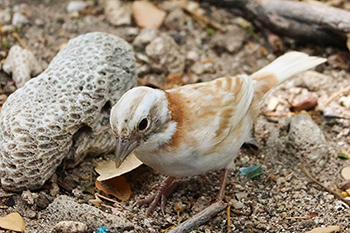
PHOTO TOM LACROIX
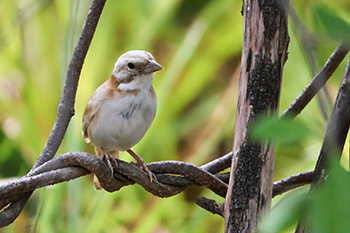
PHOTO TOM LACROIX

 Bird Watching Curaçao - HOME