
This article was published in Antilliaans Dagblad on Tuesday May 26, 2026
If you want to read the article in Dutch please go to the article on our affiliated website Biology: Leucism in the animal world – Caribbean Footprint
Humans identify animal species based on the habitat in which they occur, the behavior of the animals in question, the sounds they produce, the shapes the animals have, and the colors they display. At a quick glance, the registration of color is even one of the most important factors by which most people classify animals. Think of seeing a bird. Even if the bird in question flies past very quickly, but you see a deep orange color in a fraction of a second and you are on either one of the 3 islands, Aruba, Bonaire or Curaçao, you will immediately conclude that it was an (Venezuelan) trupial. But sometimes nature tricks us, and suddenly there is an individual that has a different coloration, causing us to wonder what we actually saw. That is what recently happened to Willemijn Riedijk at Landhuis San Nicolas on Curaçao.
A Strange Bird
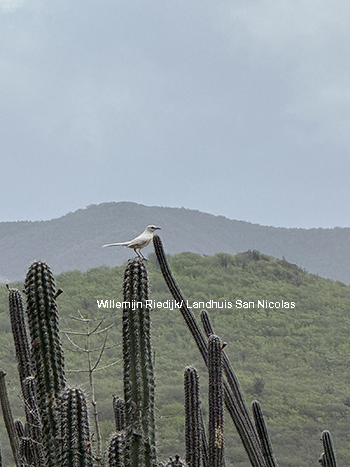
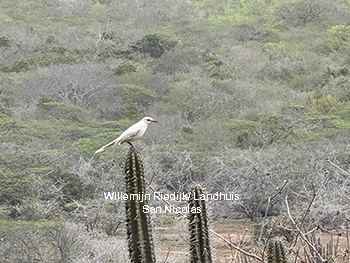
Last week, a message arrived on the Bird Watching Curaçao Facebook page containing a series of photos and videos of a peculiar-looking bird at Landhuis San Nicolas on the island of Curaçao, asking what special species this was. As can be seen in the photos in this article, it was a cream-colored, almost white bird with a long tail, dark legs, a dark beak, and brown eyes. Anyone paying attention to the shape of the bird and mentally comparing it to the known local bird shapes stored in the brain will immediately think of a Chuchubi or a Tropical Mockingbird (Mimus gilvus rostratus). But then doubt sets in, as the colour is absolutely not right. Tropical mockingbirds are silver-grey in colour with a dark grey Zorro mask around the eyes, dark grey wing feathers, and a tail with dark grey patterns and white tips. Not the this cream-white colour with hardly any dark markings. And yet, the animal in the photo is indeed a Chuchubi, albeit with a colour anomaly. The next conclusion might then be that this particular individual is perhaps an albino, a bird lacking pigment. However, the animal does indeed have markings and, moreover, the most important characteristic: normally coloured brown eyes instead of red eyes, as is usually the case with albino individuals. So, not an albino, but what then?
In nature, various colour abnormalities can occur in animals, including birds. Albinism is indeed one of them, but an even more common abnormality is so-called leucism; an abnormality in the pigment cells that leads to reduced pigmentation and can affect all types of pigments.
Albinism versus Leucism
Albinism is caused by a genetic mutation that prevents pigment production (melanin) in an organism’s cells, causing it to stop completely. This results in an absence of pigment in the skin, hair, scales, feathers, and eyes, creating an organism that is entirely ‘white’ with red eyes due to the underlying blood vessels showing through in the iris. However, not all albino individuals have completely red eyes.
It is a phenomenon that can occur in both mammals and other vertebrates, such as birds. In certain cases, humans specifically breed animals with this genetic mutation to produce pure white individuals with red eyes. Examples include the white rabbits with red eyes or the white hamsters with red eyes that are popular in pet shops. However, these albino animals usually do not live long, even in captivity, because people often fail to take sufficient account of the limiting factors affecting these animals. For instance, they often have problems with their eyes and vision and are sensitive to sunlight.
Leucism, on the other hand, is not so much a genetic mutation, but rather a condition that causes reduced pigmentation. The pigment cells do not develop properly, resulting in a complete or only partial loss of colour in the skin, fur, feathers, or scales. This does not apply to the pigments in the eyes, and therefore organisms with leucism have eyes with a normal colour. In the case of the Chuchubi at San Nicolas, therefore, ordinary brown eyes, just like all Chuchubis.
Leucism can manifest itself in various ways. Sometimes an organism with leucism has only a few colourless spots on the skin, scales, or feathers (sometimes even just one white feather, for example) alongside the normal colours of the species, and in other cases, the individual is completely uncoloured. This is because leucism involves defects in the pigment cells themselves. These cells either do not develop properly during embryonic growth, or they produce less pigment. The condition can affect all types of pigmentation, including not only melanin but also the pigments responsible for other colours, including red, orange, and yellow. As a result, white spots can develop in both the dark and light colour zones of animals.
Leucism on Curaçao and Bonaire
The photos of the leucistic Chuchubi at Landhuis San Nicolas on Curaçao can be considered quite unique, in the sense that it is rare for a leucistic bird of this species to be spotted and captured on the island. The animal’s coloration is striking, not only to observant people but also to predators targeting birds. There are few predators on the island that have a Tropical mockingbird on their menu. Apart from feral cats, these are mainly birds of prey such as the migrating Merlin and Peregrine Falcon, and perhaps a local American Kestrel. In practice, therefore, animals with leucism will stand out more because they have lost their camouflage colour and pattern and can thus easily fall prey to predators. The Chuchubi, a fairly vocal and visually prominent bird species, will likely not suffer much disadvantage from its colour variation.
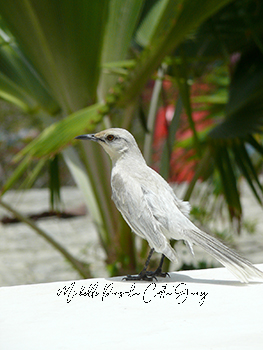
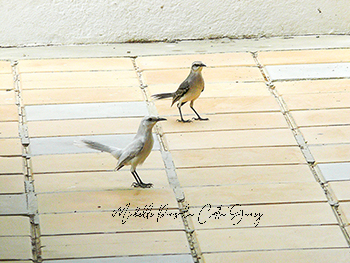
I previously spotted leucistic Caribbean mockingbirds myself on the sister island of Bonaire. In the vicinity of Mangazina di Rei, the culturally rich hotspot in the village of Rincon, an almost pure white Chuchubi with normally coloured eyes sat next to his partner, a normally coloured Chuchubi (see photo). That was in 2014. A few years later, when we were there again, the group of leucistic Chuchubis had expanded to about 4 (that we were able to count). I am curious whether the group has expanded further by 2026 and whether there are more individuals flying around with this special colour variation.
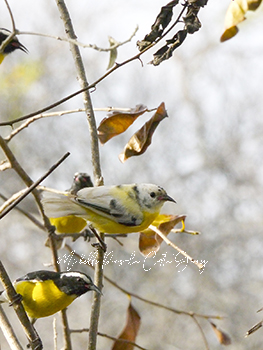
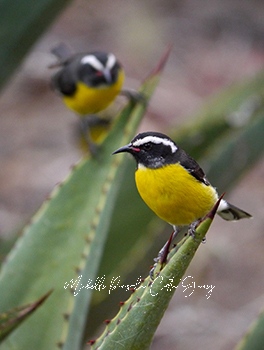
Another bird species on Curaçao in which color anomalies are regularly observed and which is also frequently photographed is the Bananaquit or Barika hel (Coereba flaveola uropygialis on Curaçao and Aruba and the Coereba flaveola bonairensis on Bonaire)). These busy, agile birds normally have a characteristic black ‘coat’—the back and wings are black—and a yellow belly. But in locations where large groups gather, for example where a lot of sugar is used for feeding, birds have been spotted that do have the beautiful yellow belly, but no black coat. The back and wings are then either completely white, white-spotted, or white with a few black spots. Otherwise, the eye colour is exactly the same as that of the ‘normally’ coloured birds, and the beak and legs also have the normal colour. These are also leucistic Bananaquits with pigment cells that have not developed properly. It is striking that these special animals are mainly seen in places where refined sugar is fed frequently and for prolonged periods. This addictive substance is not only unhealthy for humans. Birds also develop health problems from eating excessive sugar. A number of conditions that birds can get from eating this include obesity, liver disorders, cardiovascular diseases, and deficiencies in vitamins and minerals that can lead to (birth) defects. The advice is therefore always not to feed birds sugar, no matter how tasty they find it. If you want to feed them, presenting naturally sweet fruit is best. Think of bananas, (water)melon, and mango (overripe fruit is also fine), and above all, most importantly: multiple bowls of fresh drinking water. To drink from and bathe in.
With many thanks to Willemijn Riedijk of Landhuis San Nicolas for the photos of the leucistic Chuchubi on Curaçao.
Do you also have a question about the local nature or a special photo you would like an explanation for? Then email it to us at info@caribbeanfootprint.com.

 Bird Watching Curaçao - HOME