
Every year, hundreds to thousands of birds come to the island of Curaçao to produce their offspring. During the period from mid-March to well into late August, and sometimes even mid-September, various species of terns, gulls, and other bird species come to our island, as well as to Bonaire and Aruba, to search the coast for suitable breeding sites to raise their young. Least Terns, Sandwich Terns, Royal Terns, Common Terns, and Laughing Gulls are a handful of these species that do so. From mid-March onward, warnings are already issued in various areas that the breeding season has arrived and that visitors must be careful not to disturb the birds. In the salt pans of Jan Thiel and Sami Liber, the coastal strip of Playa Kanoa, Koraal Tabak, Shete Boka, Ascencion, Klein Curaçao, and various small areas elsewhere on the island, the birds arrive in mid-March and then choose a spot to breed individually or in groups. This selection process can already be disrupted by the presence of unleashed dogs or human recreationists, so it is important for it to proceed smoothly for a success reproductive story.
Be responsible
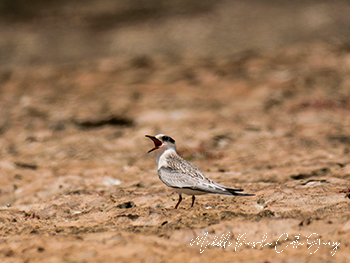
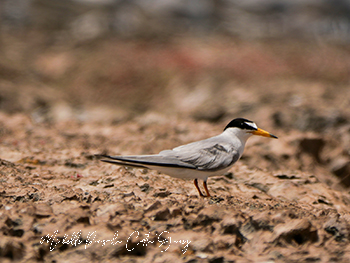
Once this selection process has finally succeeded, the partners have found each other, and mating has taken place, eggs can be laid. Sometimes somewhat sheltered, right next to a small limestone rock, or simply out in the open on the bare limestone ground without protection against wind, rain, or sun. The parents are responsible for this protection with their bodies and sit on the eggs to protect them from the elements. Even then, the nests and the parents are vulnerable. Feral cats like to hunt the sitting parents, and rats, mice, and even other bird species come to see if they can steal an egg. Hikers, cyclists, and others who get too close to the breeding colony are attacked by sometimes multiple adult birds that first fly up with loud screeching, then whiz past your head with that same screeching, and if you still don’t listen, may even peck at your head or defecate on you. All of these are warnings that you are causing a disturbance to these animals. The only correct solution in this situation is to turn around immediately and leave the area. Because of the fact that the eggs lie on the ground and are well camouflaged, you only see them when you are standing right on top of them. And who wants to have on their conscience that they wilfully and knowingly destroyed a nest?
Precocial birds
The chicks that eventually hatch are precocial. They wander off from the nest immediately after hatching and seek shelter under stones and rocks or under their parents, who fly back and forth with small fish. That is one of the reasons why so-called ‘rock stacking’, where people build piles of stones believing they are participating in an international craze, can cause such enormous damage. After all, the young birds can no longer find shelter, and if they do so under a wobbly pile of stones, they also run the risk of being crushed by falling stones. As a ‘rock stacker,’ that is than something you can proudly add to your CV. Despite international campaigns to put an end to these practices, there are still even guides who encourage this behaviour among visitors on the island. Of course, there are other harmful consequences of this stacking frenzy, but that is for another article.
Learning to fly
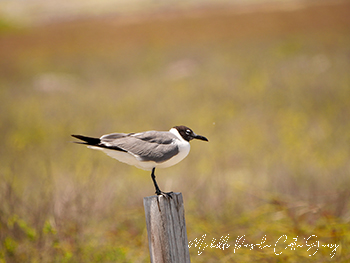
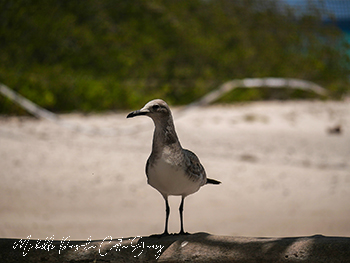
Once the parents of these birds have finally managed to raise the young, the next precarious phase begins: learning to fly. Terns and gulls cover great distances over the sea and therefore must be excellent fliers. This learning process is intensive and exhausting for the small birds and must therefore take place undisturbed. Once they can finally successfully cover short distances, they eventually join their parents at the resting places found across the island. And then you suddenly see young Sandwich Terns, young Least Terns, and young Laughing Gulls, for example, sitting near the salt pans, or at Playa Kanoa, for instance. The young birds can be recognized by their smaller size, their somewhat grayish or brownish appearance lacking the adult markings, and especially the fact that they still beg their parents for a fish. Their own fishing training is not yet advanced enough for them to do this independently, so they certainly still receive some from their parents. The photos accompanying this article show, among others, a young Laughing Gull—probably born somewhere on Curaçao this year—an adult Laughing Gull for comparison, as well as a young and an adult American Little Tern. Of these, the chick was certainly born on Curaçao.


