In May of this year we posted an article with photos by Willemijn Riedijk of Landhuis San Nicolas on Curaçao of a leucistic Tropical mockingbird in that area including the explanation of what leucism is exactly and how it becomes visible in birds. A few weeks later photographer Tom Lacroix shared a series of a Rufous-collared sparrow (Zonotrichia capensis insularis) in the restaurant of Playa Porto Marie on Curaçao that also displayed leucism making the individual very visible among the other birds of its species present in the location.
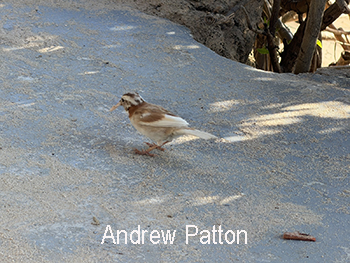
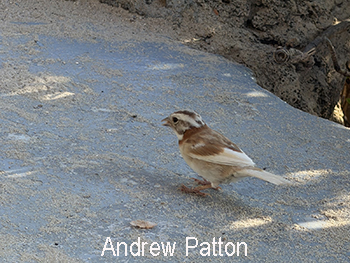
This a follow up to the sighting of that particular bird from October 2026, with photos from island visitor and photographer Andrew Patton who visited the beach and restaurant and managed to capture the bird with his camera.
It is important to summarize the definition of leucism once again as animals that have leucism are often erroneously considered to be albinos. Albinism is a genetic mutation and leucism is not. Leucism is an abnormality in the pigment cells that leads to reduced pigmentation and can affect all types of pigments. Due to the abnormality in the aforementioned pigment cells, they do not develop properly, resulting in a complete or only partial loss of colour in the skin, fur, feathers, or scales of vertebrates. Mammals, birds, reptiles, amphibians, and fish can therefore all exhibit this phenomenon. The abnormality in the pigment cells does not affect the eyes, meaning that organisms with leucism have normally coloured eyes, rather than red ones as is the case with albinism. Leucism characteristics come in various ways, from organisms that lack certain pigment all over the body to individuals displaying only spots of pigment-less scales, feathers or hair. This is because leucism involves defects in the pigment cells themselves. These cells either do not develop properly during embryonic growth, or they produce less pigment. The condition can affect all types of pigmentation, including not only melanin but also the pigments responsible for other colours, such as red, orange, and yellow. As a result, white spots can develop in both the dark and light colour zones of the animals.
The Rufous-collared sparrow described earlier in June (READ HERE), is completely creamy white, with some darker markings still visible.
It can be difficult for animals that have a deviant colouration than their peers to survive in the wild as the are much more conspicuous to predators making them very vulnerable. We were wondering if the Rufous-collared sparrow in question, which appeared to be an adult bird in the earlier photos, would survive for a longer period so we went in search of the bird in July and August. We couldn’t access the area of the restaurant as both the beach and the restaurant were too crowded. Than we received the email by Mr. Patton in October with photos of what appears to be the same leucistic bird that was seen and photographed in June, taken on October 18. In the photos, the bird is seen hopping around the bar area of the restaurant of Porto Marie, eating what appears to be crumbs from the sandy floor. Its plumage appears to be healthy, with the rufous collar more deeply coloured than before.
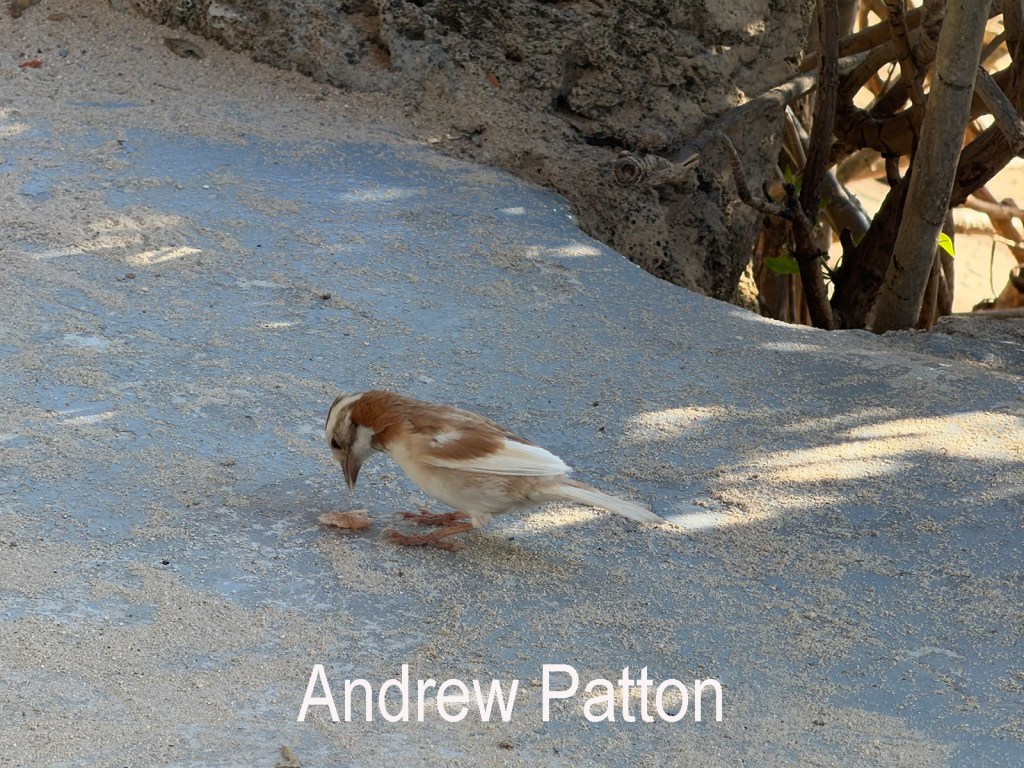
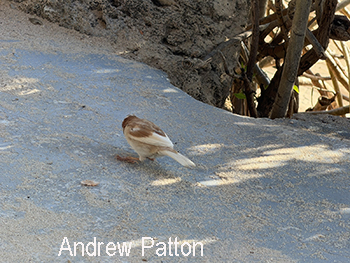
It is always difficult to say with a 100% certainty that it is the same bird as was seen in the month of June, as feathers wear out, subtly changing form and coloration over time, and birds molt continuously. However, there have been no report of more leucistic birds of the species seen in this specific area over the last couple of months. That is why we urge visitors to the area to look out for this interesting looking bird and continue reporting its sightings with photos if possible. This will give valuable information on the survival rate of these rare animals and circumstances for their survival.
As Mr. Patton wrote in his mail: “I’m not a birdwatcher or wildlife photographer, just someone who happened to notice an unusual little bird while enjoying a day at Playa Porto Mari. I took a few photos out of curiosity, and later asked ChatGPT to help identify it. To my surprise, it led me to your June article about what appeared to be the very same bird!”.
Every sighting counts!